Implantation Cramps: What They Feel Like and When They Happen
What implantation cramps feel like, when they happen after ovulation, how implantation bleeding differs from a period, and when to take a pregnancy test.
By Nitya Health Editorial Team7 min read

If you are hoping to get pregnant, every twinge in the days before your period can feel like a clue. One sign people often search for is implantation cramping — mild discomfort that some people notice when a fertilised egg settles into the lining of the uterus.
Here is what implantation actually is, what the cramps may feel like, how to tell implantation bleeding from a period, and when a test will give you a real answer. One important point up front: many pregnant people feel nothing at all during implantation, and cramps on their own can never confirm a pregnancy.
What is implantation?
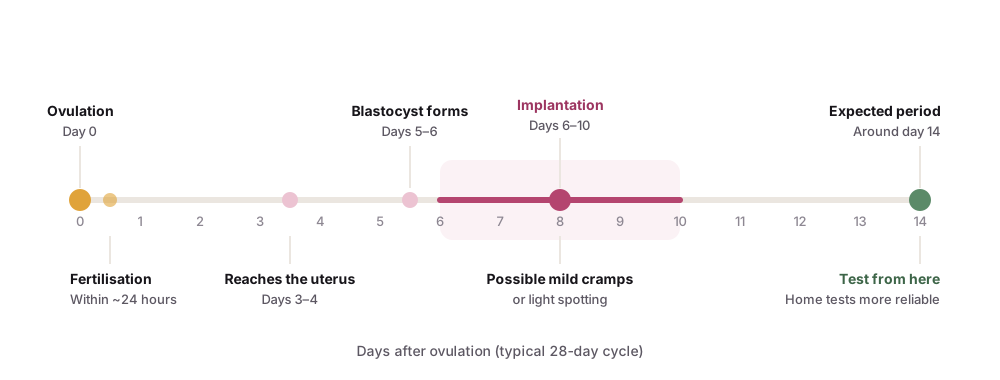
After ovulation, the egg travels down the fallopian tube. If it meets sperm and is fertilised, it begins dividing as it moves towards the uterus over the next few days. By around day five or six after ovulation, it has become a hollow ball of cells called a blastocyst.
The blastocyst then attaches to and embeds itself in the endometrium, the thick, nourishing lining of the uterus. This usually happens around 6 to 10 days after ovulation. Once implanted, the developing placenta starts producing hCG (human chorionic gonadotropin) — the hormone that pregnancy tests detect.
To understand where this fits in your cycle, it helps to know how the luteal phase works — our guide to the phases of the menstrual cycle explains it step by step.
What do implantation cramps feel like?
Not everyone experiences them, and those who do usually describe them as subtle. Implantation cramps, when they happen, tend to be:
- Mild — a dull ache, light pulling or tingling, rather than sharp pain
- Low and central — felt in the lower abdomen or lower back
- Short — lasting a few hours, or coming and going over a day or two
- Without a build-up — they do not usually intensify the way period cramps can
Some people also notice light spotting at around the same time. Others notice general early pregnancy signs later on, such as tender breasts, tiredness or needing to pass urine more often — but these can also happen before a period, so they are not reliable on their own.
When do they happen?
In a typical 28-day cycle, ovulation is around day 14 and implantation around days 20–24. That means any implantation cramping would usually come several days before your period is due — not on the day your period was expected. If your cycles are longer or shorter, the timing shifts with your ovulation date.
Implantation bleeding vs a period
Some people notice a small amount of spotting around implantation. Because it can come close to when a period is expected, it is easy to confuse the two. These differences can help, although there is a lot of overlap from person to person.
| Feature | Implantation bleeding | Period |
|---|---|---|
| Colour | Light pink or brown | Usually bright to dark red, sometimes brown at the start or end |
| Flow | Very light spotting; may only show when wiping or as a few spots on underwear | Starts light or medium and usually gets heavier, needing a pad, tampon or cup |
| Duration | A few hours to about two days | Usually 3–7 days |
| Clots | Not expected | Small clots can be normal, especially on heavier days |
| Cramps | Mild or none | Can range from mild to strong, often worst in the first day or two |
| Timing | Around 6–10 days after ovulation, often a few days before the expected period | Around when your period is due |
Spotting that is pink or brown and stops on its own within a day or two is often harmless — but if you could be pregnant and the bleeding becomes heavy or painful, see a doctor rather than waiting to see what happens.
Brown spotting can have many causes besides implantation. If you are curious about what different shades mean, read our guide to dark brown period blood.
Implantation cramps vs PMS cramps
This is where things get tricky, because the hormone progesterone is high in the second half of every cycle, whether or not you are pregnant. It can cause bloating, breast tenderness, mood changes and mild cramping in both situations.
| Implantation cramps | PMS cramps | |
|---|---|---|
| Usual timing | 6–10 days after ovulation | A day or two before your period, continuing into it |
| Intensity | Mild, light twinges | Mild to strong, may build up |
| What follows | Possibly a missed period | Your period starts |
In practice, it is not possible to tell the two apart reliably by feel alone. The only way to know is to wait and take a pregnancy test at the right time.
When to take a pregnancy test
Home urine tests detect hCG, which only starts to be produced after implantation and then rises over the following days. Testing too early is one of the most common reasons for a disappointing negative result.
- Best time: from the first day of your missed period. Many tests can pick up a pregnancy around this time.
- Use first-morning urine if you are testing early, as it is more concentrated.
- If the result is negative but your period still has not come, test again after two to three days.
- If you have irregular cycles, test about three weeks after unprotected sex, or ask your doctor.
- A blood test (beta-hCG) done at a lab can detect lower levels of hCG and can be repeated to see whether levels are rising as expected.
A faint positive line usually still means hCG is present. If you get a positive result, book an appointment with your gynaecologist to confirm the pregnancy and plan your antenatal care.
Track your cycle to time it right
Knowing when you ovulate makes the timing much clearer. Logging your period dates, cervical mucus and symptoms in the Nitya Health app can help you estimate your fertile window and know when your period is actually late. Our guide to signs of ovulation explains what to look for.
Why many people feel nothing at all
Implantation is a microscopic process. The blastocyst is smaller than a grain of sand, and the lining of the uterus is designed to receive it. So it is not surprising that most people do not feel anything specific when it happens — and that is no cause for worry.
It is also worth knowing that mild lower-tummy aches are very common in the second half of any cycle. Gas, constipation, ovulation-related twinges and the normal effects of progesterone can all feel similar. Paying close attention during the two-week wait often makes us notice sensations we would usually ignore.
Other early signs of pregnancy
After a missed period, some people begin to notice:
- Tender, fuller or tingly breasts
- Tiredness that feels unusual for you
- Nausea, with or without vomiting, at any time of day
- Needing to pass urine more often
- A heightened sense of smell or new food aversions
- A change in vaginal discharge
None of these can confirm a pregnancy on their own, because several also appear before a period. A test is the only reliable answer.
If you feel crampy
Resting, a warm (not hot) compress on your lower tummy, drinking enough water and gentle walking may help mild discomfort. If there is any chance you could be pregnant, check with a doctor or pharmacist before taking painkillers, as not all of them are recommended in pregnancy.
Red flags: when cramping is not normal
Mild cramping in early pregnancy is common. But some symptoms can point to an ectopic pregnancy (where the pregnancy implants outside the uterus, usually in a fallopian tube) or a miscarriage, and need urgent medical attention.
Go to a hospital or emergency department straight away if you have a positive test, or could be pregnant, and notice:
- Severe or persistent pain, especially on one side of the lower abdomen
- Heavy vaginal bleeding, or bleeding with clots
- Shoulder-tip pain — pain where your shoulder meets your arm, which can be a sign of internal bleeding
- Dizziness, fainting, a racing heartbeat or feeling very unwell
- Pain when passing urine or opening your bowels, or diarrhoea with abdominal pain
An ectopic pregnancy can become a medical emergency, so do not wait for a scheduled appointment if you have these symptoms.
When to see a doctor
Make an appointment with a gynaecologist if:
- You get a positive pregnancy test — to confirm the pregnancy and start antenatal care
- Your period is more than a week late and your tests are negative
- You have spotting that lasts more than a couple of days or keeps coming back
- You have cramps that are stronger than your usual period pain
- You have been trying to conceive for 12 months (or 6 months if you are 35 or older) without success
Try to be gentle with yourself during the two-week wait. Analysing every sensation is natural, but the honest answer only comes with a well-timed test — and whatever the result, your doctor can help you with the next step.
Frequently asked questions
How many days after ovulation do implantation cramps happen?
Implantation usually happens around 6 to 10 days after ovulation. Any cramping linked to it would be expected in that window, which is often a few days before your period is due.
How long do implantation cramps last?
If they happen at all, implantation cramps are usually mild and short-lived, lasting from a few hours to a day or two. Cramps that are severe or keep getting worse should be checked by a doctor.
Can I have implantation cramps and no bleeding?
Yes. Many people notice neither cramps nor spotting, and some notice only one. Feeling nothing at all is completely normal and says nothing about whether you are pregnant.
When should I take a pregnancy test after implantation cramps?
Wait until at least the first day of your missed period for the most reliable result. Testing earlier can give a false negative because hCG levels may still be too low to detect.
- #implantation
- #early pregnancy
- #pregnancy test
- #spotting
- #cramps
Track it with Nitya Health
Log your cycle, symptoms and habits — and get answers from an AI health coach.